The workshop is your sanctuary, but a cluttered, inefficient space is a creative bottleneck.
If you are using a job site table saw without an adequate workbench, you are not just compromising safety; you are suffocating your potential.
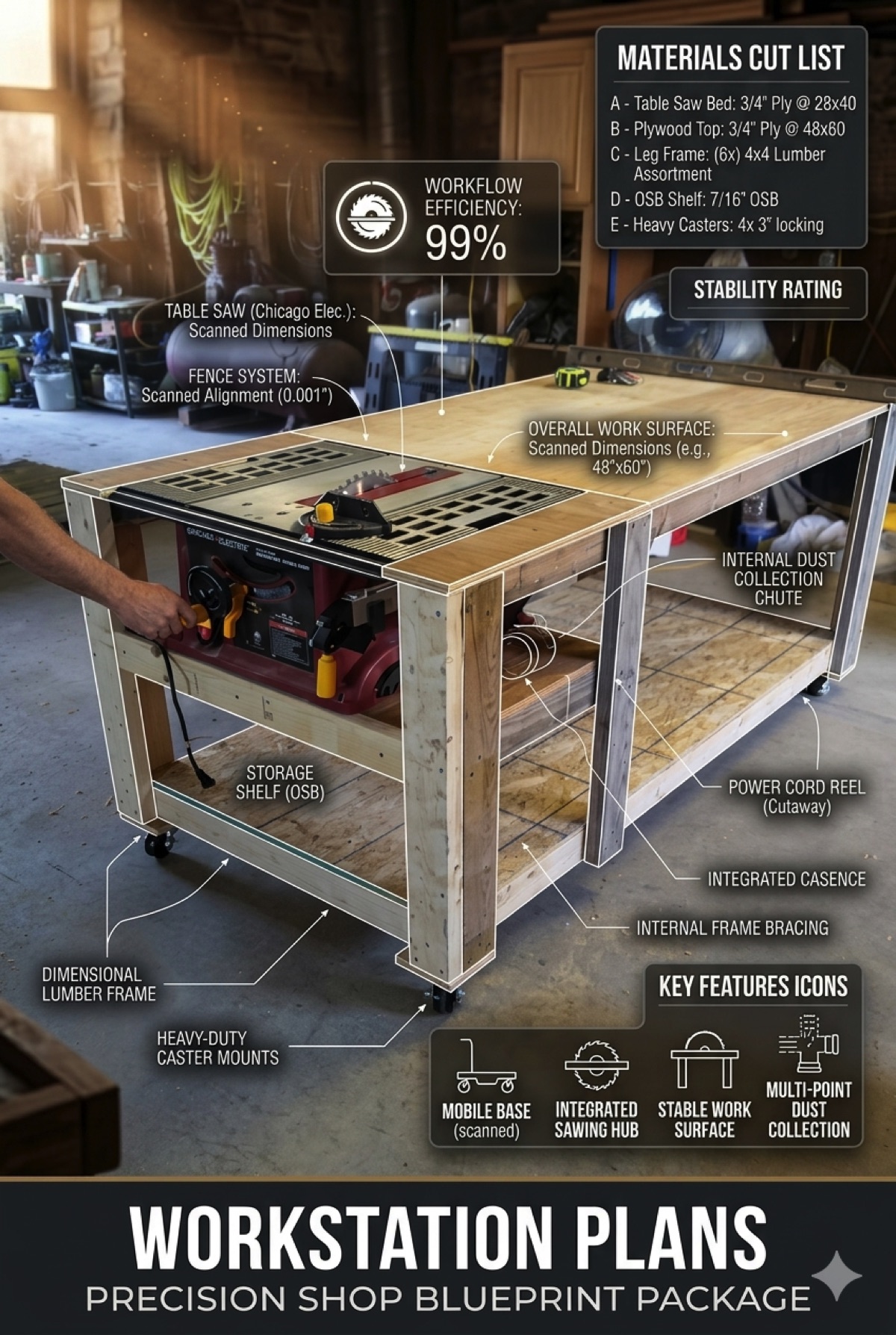
Project Blueprint Details
Stop guessing measurements. Get the exact cut lists and 3D diagrams to finish this project without mistakes.
ACCESS COMPLETE PROJECT VAULT >>Are You Tired of Compromising Your Craft?
Attention: Stop making excuses for inaccurate cuts and dangerous, unstable setups.
Every project you start with a wobbly table saw is a battle against your tools rather than a collaboration with them.
Interest: Imagine walking into your shop and seeing a perfectly integrated, mobile Workstation that has a perfect place for your saw, your fence, and your materials.
Imagine an outfeed surface large enough for full sheets of plywood, an organized lower shelf for heavy tools, and an integrated dust management system that finally keeps the air breathable.
This isn’t just a basic workbench project; it is a professional-grade hub, a Shop Blueprint Package engineered to turn your small-scale saw into a powerful, precision machining center.
Desire: Our team developed this workstation blueprint after hearing thousands of woodworkers say their job site saw was the biggest limitation in their shop flow.
This specific design features a precision 0.001″ fence alignment guide and an internal dust collection chute, built using stable dimensional lumber and high-density plywood.
You deserve a tool setup that works as hard as you do, that empowers you to execute flawless mortises, clean ripping cuts, and repeatable joinery, all in a compact, mobile footprint.
Action: Don’t waste another weekend battling your saw—start building your masterpiece.
Why This Exact Blueprint Transforms Your Shop Dynamics
The successful workshop doesn’t happen by accident; it is structured on three critical performance pillars: mobile accessibility, integrated sawing workflow, and rigid stability.
Job site saw stands often fail the first test of stability and collapse under heavy stock, but this dimensional lumber frame is built like a tank to eliminate vibration.
By maximizing vertical square footage and implementing a multi-point dust collection network, you create a system that finally contains the ‘dust-volcano’ of ripping cuts.
Keeping your outfeed support locked at the perfect height allows for instant, safe sheet goods processing, ensuring you never have to ask for help with a cut again.
The internal frame bracing system and heavy-duty caster mounts create a mobilized unit that can be reconfigured in seconds, maximizing floor area in any garage or small shop.
Your Blueprint to Workstation Perfection: A Quick 7-Step Guide
| Step | Milestone | Expert Tip |
|---|---|---|
| 1 | Scan and Prep | Thoroughly review the included Material Cut List and gather your 3/4″ Ply and 4×4 lumber. |
| 2 | Frame Assembly | Focus on getting the dimensional lumber leg frame perfectly square; this is your structural foundation. |
| 3 | Mobile Base | Install the heavy-duty caster mounts before the main workbench gets too heavy to flip easily. |
| 4 | Integrated Hub | Precisely position the inner shelf and the dimensional lumber bracing to cradle your specific saw model. |
| 5 | Top Surface | Install the 3/4″ Plywood bed, ensuring it provides seamless outfeed support with the saw’s table surface. |
| 6 | Dust Management | Construct the internal dust collection chute below the saw; do not skip this critical health and cleanliness step. |
| 7 | Final Setup | Calibrate your fence alignment using the integrated gauge and enjoy your stable work surface. |
PRO-TIP: The Alignment Absolute
The most critical step is Step 5.
Use an engineer’s straightedge to verify the workstation top is absolutely flush with the saw table.
Even a 1/64″ deviation in either direction can lead to kickback risks or inaccurate cuts on long stock.
Understanding The Blueprint’s True Value for Your Workflow
This isn’t just a list of cuts; it is a comprehensive guide to maximizing your creativity.
We spent months engineering the dust chute angle to work effectively with standard workshop vacuum systems.
The internal plywood joinery specifications are modeled after heavy-duty industrial furniture.
This blueprint includes details on internal plywood management, helping you utilize offcuts for drawer boxes or tool dividers on the lower OSB storage shelf.
The overall workstation width is designed to fit through standard 36″ shop doors while still maximizing your sawing footprint.
We analyzed common fence alignment failures on job site saws and integrated a solution into the workstation design.
The stability rating on this frame is unmatched by any commercial saw stand.
Building this workstation will teach you essential carpentry and integration skills you will use in every future build.
We recommend finishing the plywood top with a simple polyurethane coat to create a slick surface for sheet goods.
By the end of this project, you will have a high-functioning piece of shop furniture that you are proud to show off.
Frequently Asked Questions (FAQ)
Is this workstation only for the Chicago Electric saw in the photo?
Our blueprint is a modular ‘Scanned Dimensions’ model.
It includes a specific section on how to measure and adjust the internal cradle for your exact saw, whether it is a Bosch, DeWalt, Makita, or another job site model.
What is the best type of lumber for the frame?
For maximum rigidity, we recommend using construction-grade SPF (Spruce-Pine-Fir) dimensional 4x4s for the legs and 2x4s for the bracing, which are both stable and cost-effective.
Can I build this by myself?
Yes, this is an intermediate-level woodworking project that can easily be completed by one person over a full weekend.
However, having a second person for flipping the main frame during caster installation is very helpful.
Will the 3-inch locking casters in the plan hold the weight?
The casters specified in our Material List are heavy-duty models with a total load capacity of 800+ lbs, more than double the estimated finished workstation weight.
This ensures the workstation remains stable even under the largest project loads.
What level of accuracy can I expect?
The precision is in the execution, but our blueprint gives you the framework (like the integrated fence alignment guide) to achieve accurate ripping, crosscuts, and repeatability within 0.001″.
This allows your saw to achieve performance metrics usually reserved for large cabinet saws.
Achieve the Workshop of Your Dreams Today
Your best work is currently waiting for you to create a space capable of producing it.
Do not allow shop chaos to steal any more of your creative energy or compromise your finished results.
Get the complete Workstation PLANS: Precision Shop Blueprint Package now and finally take command of your workshop.
The complete drawing package includes a full Material Matrix, a comprehensive Cost-Calculator, and step-by-step high-resolution assembly diagrams.
Everything you need to successfully build a professional mobile hub is included.
[DOWNLOAD THE FULL BLUEPRINT PACKAGE NOW]
Project Blueprint Details
Stop guessing measurements. Get the exact cut lists and 3D diagrams to finish this project without mistakes.
ACCESS COMPLETE PROJECT VAULT >>



No Comments
Be the first to start a conversation